A Docker container is a lightweight, standalone, executable package that includes everything needed to run a piece of software: the code, the runtime, the system tools, and the libraries. This post focuses strictly on the container itself, not the images used to build them, not the engines that run them. By the end, you will have a crystal-clear understanding of this fundamental unit of modern software.
The Mental Model (The Running App in a Box)
Imagine you have an application. It requires specific files, specific libraries, and specific settings to function correctly. A Docker container is that application, plus all its needs, wrapped into one isolated box.
This box has solid walls. Nothing inside the box interferes with the outside world, and nothing outside can interfere with what’s inside. The application inside behaves exactly as designed, regardless of whether the box is placed on a developer’s laptop, a test server, or a cloud provider’s data center.
That box is a Docker container.
What a Docker Container Contains
A Docker container is not an empty shell. When you look inside a running container, it possesses its own version of almost everything an operating system provides. It carries the actual application, the code or process that runs, whether that’s a Python script or a PostgreSQL database. It carries every library, package, and binary that the application depends on, so there are never conflicts with whatever is installed on the host machine. It has its own isolated view of files and directories, its own virtual network interface with IP addresses and ports, its own set of running processes, and its own environment variables and system configurations.
When you execute a command inside a running Docker container, it looks and feels almost like a full virtual machine. But it is not. It shares the host’s operating system kernel while appearing to have its own entire system. That distinction matters, and it leads directly to the next point.
What a Container Is Not
Clarity often comes from understanding boundaries.
A Docker container is not a virtual machine. A VM includes a full guest operating system and a hypervisor sitting between it and the hardware. A container carries none of that. Containers share the host’s OS kernel, which is why they start in seconds rather than minutes and use a fraction of the memory. Same idea of isolation, fundamentally lighter execution.
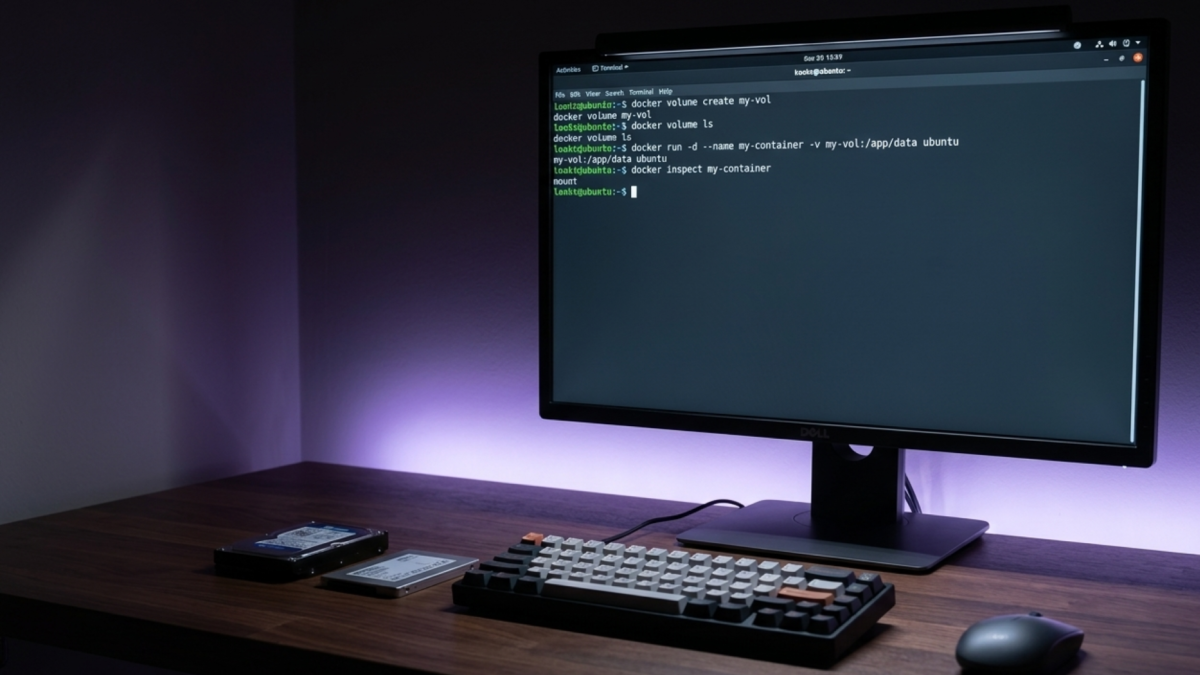
A container is also not a persistent machine. By default, when a container stops, any data written inside it disappears. Containers are ephemeral by design; they are meant to be disposable and replaceable. To save data beyond the life of a container, you use external volumes that live outside the container itself.
And a container is not an image. This is the most common point of confusion. An image is the read-only blueprint or template. A container is the read-write, running instance created from that image. Think of it like cooking: the recipe with written instructions is the Docker image. The actual dish cooking on the stove is the Docker container. One is static, one is alive.
How a Container Runs
A container runs because the host operating system provides isolation through specific Linux kernel features, such as namespaces and control groups. Namespaces give the container its own view of the system, isolating its processes, network, and filesystem so it believes it has the entire machine to itself. Control groups limit how much CPU, memory, and bandwidth the container can consume, preventing any single container from starving the rest of the host. The container doesn’t know any of this is happening. It simply runs its process, believing it has its own machine. That is the magic of containerization.
The Takeaway
A Docker container is your application, sealed with everything it needs, running in its own isolated world. It is not a VM, it is not an image, and it is not permanent. It is a lightweight, self-contained unit that starts fast, runs consistently, and can be thrown away and replaced without a second thought. Once you understand what a container actually is, this sealed, isolated, running box, every other concept in the Docker ecosystem starts to fall into place around it. This is the foundation. Everything else is built on top of it.