Ollama is an open-source tool that lets you run powerful large language models directly on your own hardware, free, private, and fully offline. No cloud, no subscription, no data leaving your machine.
What Ollama Actually Is
If you have spent any time in this series, the best way to understand Ollama is through an analogy you already know: Ollama is Docker, but for AI models.
Just as Docker lets you pull a container image from a registry, run it on your hardware, and interact with it through a consistent interface regardless of what is inside, Ollama lets you pull a language model from its library, run it on your hardware, and interact with it through a consistent interface regardless of which model you choose. The complexity of setting up each model’s environment, dependencies, and configuration is handled entirely by Ollama. You pull a model. You run it. It works.
This abstraction is what makes Ollama significant. Running a large language model from scratch requires resolving dependencies, configuring hardware acceleration, managing memory allocation, and navigating model-specific quirks. Ollama collapses all of that into a single tool with a familiar workflow.
The Model Library
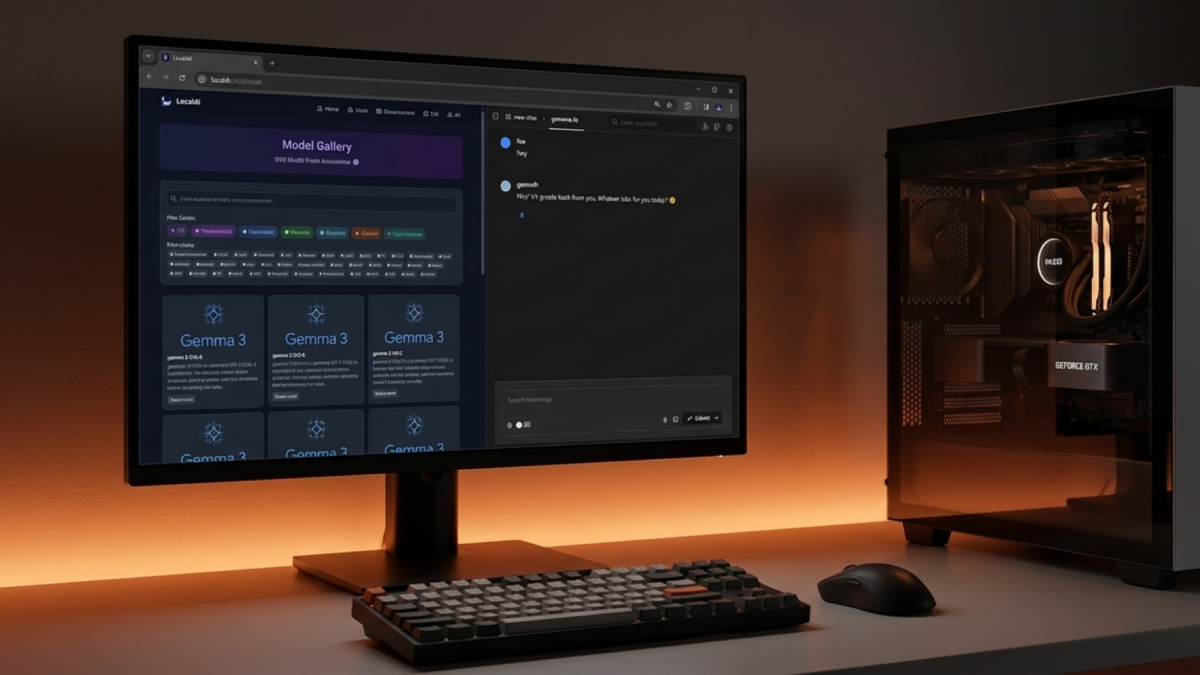
Ollama maintains a library of popular open-source models you can pull and run the same way you would pull a Docker image. The library includes general-purpose models like Meta’s Llama, reasoning-focused models like DeepSeek, lightweight models like Microsoft’s Phi that run comfortably on modest hardware, and multimodal models like LLaVA that can analyze images as well as text. There are also code-specialized models fine-tuned specifically for programming tasks.
The practical question for most homelab users is which models their hardware can actually run. A useful rule of thumb: you need roughly one gigabyte of RAM or VRAM per billion parameters for a quantized model. A seven-billion-parameter model like Mistral needs around eight gigabytes of free memory. A seventy-billion-parameter model needs sixty-four gigabytes or more. GPU memory is significantly faster than system RAM for inference, so a machine with a capable GPU will run the same model noticeably faster than one relying on CPU and system memory alone.
Most homelab hardware can run something useful today. A machine with sixteen gigabytes of RAM handles a capable seven or thirteen billion parameter model without strain, good enough for coding assistance, summarization, question answering, and general conversation.
How It Works
When Ollama runs, it starts a lightweight local server that listens for requests and handles model inference. This server exposes a REST API on your local machine, which means other applications can send prompts and receive responses programmatically, the same way they would interact with a cloud AI API, except the request never leaves your network.
The API is designed to be compatible with the OpenAI specification, which has become something of an industry standard. A large ecosystem of tools, interfaces, and applications has been built to work with that format, and many of them work with Ollama out of the box simply by pointing them at your local server address instead of a cloud endpoint.
Open WebUI, for example, provides a full ChatGPT-style browser interface that connects directly to Ollama and gives every device on your network access to your local models through a polished interface, no cloud account required. A machine running Ollama with Open WebUI becomes a private AI server for your entire household. Every phone, laptop, and tablet on your network can access it. Nothing leaves your network. No rate limits, no subscription tiers, no terms of service governing what you can ask.
Why It Belongs in a Homelab
The homelab philosophy is about owning your infrastructure and understanding what it does. Ollama fits that philosophy precisely. You choose which models run on your hardware. You control who on your network can access them. You decide what data gets sent to them and what stays private.
For developers, the local API means you can build applications, scripts, and automations that use language model inference without incurring per-token costs or rate limit constraints. For privacy-conscious users, it means AI assistance for sensitive tasks, reviewing private documents, analyzing personal data, and working with proprietary code without any of that material leaving the machine.
The Takeaway
Ollama is to AI models what Docker is to applications: a tool that takes something technically complex and makes it operationally simple. It gives you a library of powerful open-source models, a consistent interface for running them, and a local API that connects to the broader ecosystem of tools built around language model inference. Your models, your hardware, your data, your control. Everything built on local AI in your homelab starts here.