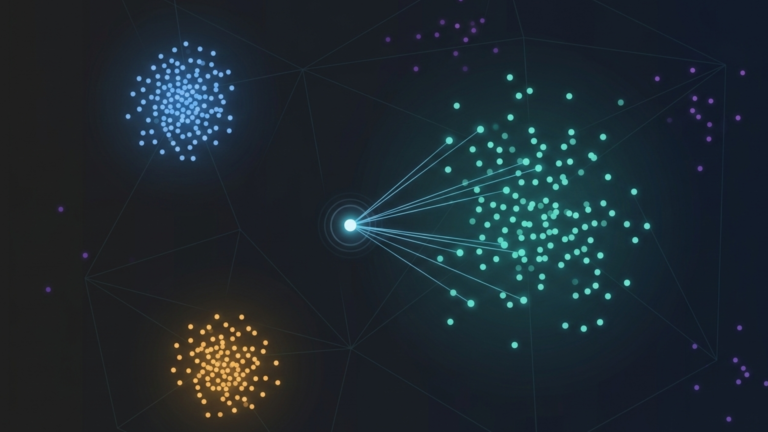
A vector database is a database built to store, index, and search vector embeddings, numerical representations of meaning extracted from text, images, audio, or any other unstructured data. It is the infrastructure layer that makes AI search feel instant, and without it, systems like RAG cannot function.
What a Vector Database Actually Is
When an AI embedding model processes a sentence, it does not store the words. It converts the sentence into a list of hundreds or thousands of numbers, a vector, where the position of those numbers in mathematical space reflects the meaning of the content. Sentences that mean similar things produce vectors that sit close together in that space. Sentences that mean different things sit far apart.
A vector database stores those points in high-dimensional space and makes it possible to search them by proximity rather than by value. Instead of asking “find me the row where this column equals this value,” you ask “find me the points in space closest to this query.” The result is a search that understands meaning, not just keywords.
The analogy that works best: imagine a library where books are shelved not by title or author, but by topic and theme so that everything about climate science clusters in one area, everything about cooking clusters in another, and books that touch on both sit somewhere between them. A vector database is a library, except the shelves have hundreds of dimensions, and the clustering happens automatically based on the content itself.
Why Traditional Databases Cannot Do This
The instinct is to ask whether you could just add a vector search plugin to an existing database and call it done. Some teams do exactly this. PostgreSQL with pgvector is a popular option for smaller projects. But at scale, traditional databases hit a fundamental wall.
The problem is dimensionality. A typical text embedding has 768 dimensions. The indexing structures that make traditional databases fast, B-trees, and hash indexes, were designed for data with a handful of dimensions at most. They do not degrade gracefully as dimensions increase. They collapse. Finding the nearest neighbor in 768-dimensional space using a traditional index requires calculating the distance between your query and every single stored vector, one by one. With millions of documents, that is computationally impossible in real time.
Vector-native databases solve this with a class of algorithms called Approximate Nearest Neighbor search, or ANN. The most widely used is HNSW Hierarchical Navigable Small World, which builds a layered graph structure that lets searches navigate quickly from broad clusters down to precise matches, like taking a highway to the right city before switching to local roads to find the exact address. The trade-off is a small loss of precision in exchange for a massive gain in speed. In practice, ANN returns 90 to 99 percent of the truly relevant results in a fraction of the time a brute-force search would require.
Why AI Needs One
Large language models have a fixed knowledge cutoff. They do not know your documents, your company’s internal data, or anything that happened after their training ended. Vector databases are how you give them that knowledge at query time.
When you ask a RAG system a question, the system converts your question into a vector using the same embedding model used to index the documents. The vector database searches for the document chunks whose vectors sit closest to your query vector, the chunks most semantically similar to what you asked. Those chunks get passed to the language model as context, and the model answers based on what it found rather than what it was trained on.
This is why the quality of a RAG system is so tightly bound to the quality of its vector database. Slow retrieval means slow responses. Poor similarity matching means irrelevant context. Irrelevant context means wrong answers. The vector database is not a peripheral component; it is the mechanism by which the AI knows what to say.
The same principle extends well beyond document search. Recommendation engines use vector databases to find products semantically similar to what a user has shown interest in. Fraud detection systems use them to identify transactions that cluster near known fraudulent patterns. Multimodal search, finding images that match a text description, or audio clips that match a concept, works because text, images, and audio can all be embedded into the same vector space and searched together.
The Scale of the Problem It Solves
A typical enterprise RAG deployment stores tens of millions of vectors. A search engine might store billions. Without purpose-built infrastructure for this kind of search, none of those systems could return results fast enough to be useful.
The fact that you can ask AnythingLLM a question about a 500-page document and get a cited answer in seconds is not magic. It is the result of a pipeline where your question was embedded, a vector database found the relevant chunks in milliseconds, and the language model had exactly the right context to work with. Remove the vector database from that pipeline, and the whole thing stops working.
The Takeaway
A vector database stores meaning, not just data, and searches by similarity rather than exact match. It is what makes RAG fast enough to be useful, accurate enough to be trusted, and scalable enough to handle real workloads. If embeddings are how AI represents meaning, vector databases are how AI finds it quickly enough to feel, from the outside, like it simply understands.